

Takeaways from the Federal Open Market Committee minutes
- 08.21.26
- Economy & Policy
- Commentary
Raymond James Chief Economist Eugenio J. Alemán discusses current economic conditions.
The minutes from the most recent Federal Open Market Committee (FOMC) meeting, released this week, revealed a committee that remained broadly hawkish. Policymakers continued to characterize inflation as elevated and emphasized that upside inflation risks persist. At the same time, they described an economy that was expanding at a solid pace, supported by healthy labor market conditions, robust consumer demand and continued investment tied to artificial intelligence.
The challenge with that assessment is that several of the conditions cited in the minutes appear less convincing today than they did at the conclusion of the July 28-29 FOMC meeting. AI-related investment remains a notable source of strength, but other pillars of the economy have softened. Employment growth, which began the year at a relatively strong pace, has cooled meaningfully in recent months, while revisions have reduced the strength reported earlier in the year.
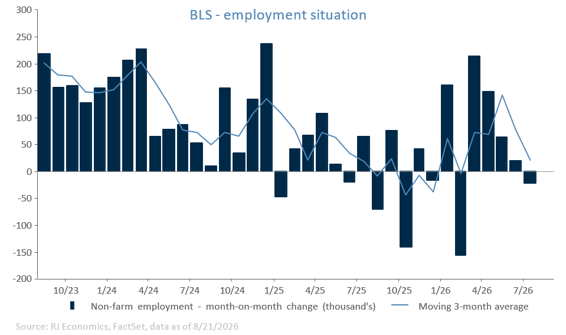
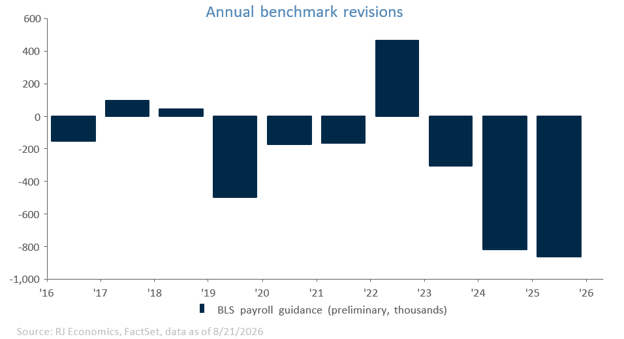
Further scrutiny of the labor market is likely when the Bureau of Labor Statistics releases its preliminary benchmark revision to nonfarm payrolls on Aug. 28. Given the sizable downward revisions seen in recent years, markets are likely to place considerable weight on the new estimates. The results could meaningfully influence both investor expectations and broader perceptions regarding the health of the labor market.
Consumer spending data have also raised some concerns. Retail and food services sales declined in July despite expectations for an increase, while control-group sales, which feed directly into the calculation of personal consumption expenditures, also weakened. As we argued last week, we continue to view this softness as more likely a temporary distortion than evidence of a sustained deterioration in consumer demand.
Several unusual factors, including the end of the FIFA World Cup and differences in the timing of Amazon Prime Day relative to last year, probably introduced considerable noise into the monthly figures. Adding to market concerns, on Aug. 20, retail giant Walmart – widely viewed as a bellwether for US consumer spending – reported its smallest quarterly comparable sales gain in over six years, with in-store sales contracting for the third consecutive quarter. Nevertheless, the weakness was sufficient to raise questions about whether the consumer remains as resilient as widely believed.
Crowding out in reverse? The US government versus AI investment
The ongoing surge in AI-related investment warrants separate discussion because it may be creating dynamics rarely observed in traditional macroeconomic frameworks.
Conventional economic theory argues that persistent fiscal deficits can crowd out private investment by increasing competition for available capital and driving borrowing costs higher. During the extended period of exceptionally low interest rates leading up to 2022, this concern largely faded from view. Private sector demand for capital was subdued, while the federal government appeared able to borrow almost without constraint and at historically low costs.
That environment has changed dramatically. Higher inflation and the Federal Reserve's tightening cycle have increased financing costs across the economy. Yet an interesting development has emerged: Long-term Treasury yields have continued moving higher even in the absence of additional Fed rate hikes.
This trend is creating additional pressure on the federal government's fiscal position as borrowing needs continue to expand. The decision by Treasury Secretary Scott Bessent this week to increase buybacks of longer-dated Treasury securities suggests a growing sensitivity within the administration to the recent rise in long-term yields.
What is particularly noteworthy, however, is that investors funding the AI buildout, including data-center construction and supporting infrastructure, appear far less deterred by higher interest rates. Expected returns on AI investments remain sufficiently attractive that financing continues to flow into the sector despite elevated borrowing costs.
In that sense, the traditional crowding-out story appears to be operating “in reverse.” Today, and this could change very quickly, the expectations on the potential future returns on investment from the AI boom are so high that, at least at the margin, the AI boom is “crowding out” the ability of the US government to access cheaper funding and not the other way around. At least for now, investors seem willing to absorb higher yields when they perceive AI-related opportunities as offering exceptional future returns.
The broader conclusion is straightforward. The FOMC minutes reflected the data available to policymakers at the time, and that information arguably justified a relatively hawkish stance. Since then, however, incoming data have painted a softer picture of economic activity. Labor market conditions have moderated, consumer spending has shown signs of cooling and growth momentum appears less robust than the committee's characterization suggests.
For that reason, we continue to believe the Federal Reserve can navigate the current inflation environment without raising interest rates this year, assuming geopolitical developments, particularly the conflict involving Iran and any resulting changes in gasoline prices, do not materially alter the inflation outlook.
At the same time, the AI investment boom remains an important exception to the broader narrative that interest rates are restrictive. The sector continues to attract capital because expected returns remain extraordinarily high. Outside of that narrow but influential segment of the economy, however, the federal government's financing needs are still likely crowding out other forms of private sector activity.
Economic and market conditions are subject to change.
Opinions are those of Investment Strategy and not necessarily those of Raymond James and are subject to change without notice. The information has been obtained from sources considered to be reliable, but we do not guarantee that the foregoing material is accurate or complete. There is no assurance any of the trends mentioned will continue or forecasts will occur. Past performance may not be indicative of future results.
